Sacred Fires
Today people draw a sharp line between Iran and Pakistan, calling one the "Middle East" and the other "South Asia." World history textbooks almost always read this back into ancient times, even when the material clearly suggests other groupings. One example of this is the migrations of the Indo-Iranian branch of the Indo-Europeans into the Iranian plateau and northern India. The common linguistic heritage brought with it a common culture, seen partly in religion.
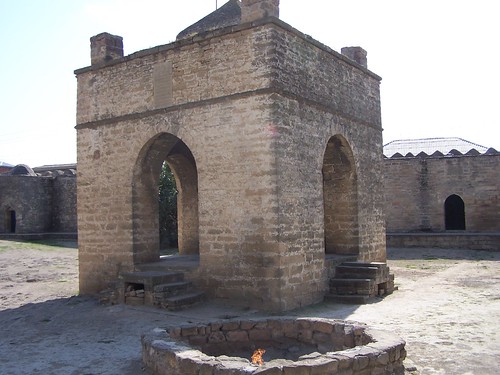
A couple of weeks ago, I mentioned the importance of fire in Zoroastrianism. According to Mary Boyce, the preeminent historian of Zoroatrianism, cults of the hearth fire began with the earliest Indo-Iranian sedentarization, and with all sacrifices, a portion, usually fatty, went to the fire. Similarly, the historian of Hinduism A.L. Basham wrote that all ancient Vedic sacrifices were mediated through Agni, the god of fire, and involved offering butter to the hearth fire in each home.
Similarly, both Zoroastrianism and Vedic worship involve three levels of fire, as well as a sacred beverage, either haoma or soma. Finally, while the sacredness of the cow is well known in Hinduism, cattle are the "sixth creation" in Zoroastrianism (fire is the seventh), and under the special protection of Ahura Mazda.
A couple of weeks ago, I mentioned the importance of fire in Zoroastrianism. According to Mary Boyce, the preeminent historian of Zoroatrianism, cults of the hearth fire began with the earliest Indo-Iranian sedentarization, and with all sacrifices, a portion, usually fatty, went to the fire. Similarly, the historian of Hinduism A.L. Basham wrote that all ancient Vedic sacrifices were mediated through Agni, the god of fire, and involved offering butter to the hearth fire in each home.
Similarly, both Zoroastrianism and Vedic worship involve three levels of fire, as well as a sacred beverage, either haoma or soma. Finally, while the sacredness of the cow is well known in Hinduism, cattle are the "sixth creation" in Zoroastrianism (fire is the seventh), and under the special protection of Ahura Mazda.
Labels: Hinduism, History, Zoroastrianism
posted by Brian Ulrich at
8:34 PM
2 Comments