Friday, July 09, 2004

Essaouira, Morocco

While I may not have done anything American for the Fourth of July, I did spend the next day wandering about Essaouira, the city of Moulay Sidi Muhammad bin Abdullah, the sultan who made Morocco the first nation to recognize American independence, even before our allies the French. The city was designed for him by a French architect so as to give Morocco a port along the Atlantic Ocean during a period when the European expansion into the Atlantic had caused a massive shift in global trade routes that affected Africa in particular.

The name of the city means "the well-designed" in Arabic, and after its completion was the main port linking Europe with Timbuktu and sub-Saharan Africa. Today its economy is based mainly off fishing, and when you walk around the port you see dozens of small fishing boats, as well as a shipyards where workmen add ribs to the skeletons of new ships as yet unpainted with the city's characteristic blue. The entire city actually smells like fish. Near the port is a large open square where around one corner you find a number of outdoor cafes and reasonably priced restaurants, while on the other you find a couple dozen or so fish stands selling the day's catch along with accompaniments for a complete meal.

Near here, too, is the fish market, where an auction is held every afternoon, though regrettably I slept through it. Essaouira proved a very restful community, where the population of only 45,000 meant few hassles and a cool sea breeze kept away the heat and actually made me wish I had brought my jacket. In fact, of the 21 hours I spent there, 12 were spent asleep in one of the medina's many cheap hotels within just a few minutes walk of the sea.

There was still plenty of time to get the feel of the place, though, with its houses all of white with blue trim, yielding only to white with reddish trim in some newer neighborhoods you see from the bus. Essaouira today is a very artsy, cosmopolitan community. The place is crowded with tourists on day trips from Marrakesh, and it is mostly to these that the restaurants mentioned above cater as the people take a break from the beaches or bird-watching. In addition, Essaouira is apparently a key destination for expats working on various intellectual or artistic projects - it actually occurs to me that one person I know who had been in Morocco earlier got to be a real live expat working on a project in Essaouira, and I freely admit that I probably would have been content to simply crash there for a couple of days and just sit in a cafe reading al-Baladhuri while staring out over the ocean.

One should not, however, give the impression that Essaouira is without Moroccan influence, however, for it is here that a large number of Moroccan artists have made their home, and I did my first souvenir shopping in the many high-quality art shops found in the streets. These included mainly paintings of scenes in Morocco which seemed influenced by impressionism, and thus easy to sell to tourists. One could also find woodcarvers, and well as the usual Moroccan arts and crafts such as leatherworking and sewing, all generally of high quality, though I didn't investigate all the prices.

Essaouira is also a major player on the Moroccan pop music scene. The current craze in Moroccan music is gnawa fusion. Gnawa is the traditional music of sub-Saharan Africans living in Morocco, most of whom came as slaves centuries ago. The "fusion" refers to blending this music with Western pop music forms to produce exciting new combinations of sound and rhythm. The same weekend I went to Caablanca, some of my friends went to Essaouira for a four-day gnawa festival which brought the top bands from all over, playing concerts which lasted well into the night. One group performing there stopped at ALIF for a workshop at which we got to try some traditional instruments such as one that was played both by plucking at the three strings and beating it like a drum, as well as metal clappers used mainly to keep rhythm. Rhythm is important to gnawa music, and the form mixed extremely well with rap.

Aside from all that, however, in some ways Essaouira can always fall back on its tradition and location if it needs to sell itself. From the main square, or even panoramically from the road leading into town, you can see the Ile de Mogador, where some birds from Madagascar come to mate. Most of the old fortifications are intact complete with cannons, and my Lonely Planet guidebook assures me they're a fascinating blend of European and Moroccan styles. The main thing I used them for was sitting and watching the ocean, one of a huge number of people sitting in the ramparts and waiting for the sun to set over the Atlantic. As an opening act, you can also watch the tide come in, with the wind blowing huge white sprays of water over high points on the ground, creating first little pools of water and then completely submerging them as it moved ever inward.

I wound up sharing a rampart with three little kids, two from Essaouira and one from Safi, who were refreshing largely because one of them spoke some Modern Standard Arabic. In Jordan and Syria, even when people didn't know MSA, they respected it as an important part of their culture. Moroccans often seem to want to disown it, and speak it only reluctantly. I think French here fills the public discourse gap MSA does elsewhere in the Arab world, and it is rather interesting how many people - most passionately an Essaouira taxi driver, have dismissed my study of Arabic while encouraging me to learn French, which they claim is the language of art and culture. Communication in Fez was initially frustrating just because so many people insist on using French with foreigners - I actually had a couple of waiters sneer at me when I forced a conversation into Arabic because I don't know French.

Since coming south, I'd also had deeper issues in terms of speaking Arabic. In Fez, I'd gotten to where I could have respectable conversations in Arabic with the people I regularly interacted with. Starting in Marrakesh, that disappeared. On the bus between Marrakesh and Essaouira, when I'd try to use a basic Arabic greeting, they'd either give me a blank look or tell me what time it was or something. Some of this may have been Berber, but I think, too, that there is a southern Moroccan accent much deeper than what I picked up in the north. In Beni Mellal, I tried to order an orange juice, and when I tried it in French he repeated back something I barely understood that was like "Jew-dor" instead of the standard French "Jus d'Orange."

It was here, however, that in a role reversal from the Aleppo suq I got my first focused lessons in Moroccan dialect, as the kids decided I needed some more dialect that just pronounciation changes and set about teaching me. Some of this came in handy - for some reason asking for a single room in a hotel just got me blank looks even with the contextual clues of a guy with a suitcase walking into a hotel - here I discovered that Moroccans use the MSA word for "house" to mean room, and at my next stop this worked like a charm. (One of those kids, incidentally, has a future in education if he wants it.)

But despite all this I admit Essaouira was for me mainly a place of rest, where I paused to relax and shop between the hectic Marrakesh and climbing around the High Atlas. It is a nice place, perhaps with a dozen like it in the world, but still free of the mess that is Fez al-Bali, the street-fight waiters of Casablanca, (see forthcoming Casablanca/Fez al-Bali write-up), the hustling of Tangier, and that sort of thing while retaining a clear sense of Moroccan culture and identity. And this city even more than Marrakesh convinced me that the south of the country is far more interesting than the north, and that the few days I'm devoting to it are not enough to do it justice.

Wednesday, July 07, 2004

Darfur in Arab Media

You know, I haven't done any sort of scientific study, but based on my exposure to the Arab media these past few weeks, I could have sworn that Darfur was generally one of the top stories. It's been up there lately, certainly, as I had breakfast to Darfur news in a cafe this morning.

Posted in response to this.

Marrakesh, Morocco

During the 11th century, somewhere in the Sahara, a confederation of Berber tribes called the Sanhaja decided the peoples around them needed to be more Islamic, and began a series of wars to spread their puritanical beliefs. First they subjugated some lands south of the Sahara, then turned northward to smash the minor potentates which dominated Morocco before heading into Spain. And it was this group, known to history as the Almoravids, who built a brand new city for their capital: Marrakesh, lying on the plains across the Atlas from the Sahara in southern Morocco, a red jewel in the middle of a yellowish landscape alive with tradition and modernity intertwined in a variety of different ways.

Like almost every other Moroccan city, Marrakesh boasts both a Ville Nouvelle and a medina, though here they resemble each other more than usual as the French continued to build with the off-pink mud used in the medina and the medina itself has far more open spaces than those further north. Most of the medieval architecture dates not from the Almoravids, but rather from their successors the Almohads, Berbers from the High Atlas who decided that Almoravid religious conservatism didn't go far enough and took their place after only a few decades. Thus the walls of the city are in the same squat functional style as of Fez, as in both cities the Almohads destroyed the original fortifications and rebuilt them only when they became convinced the population wouldn't rebel.

Marrakesh also resembles Fez in that both cities thrive off tourism. I read somewhere that 40% of the officially employed workforce in those two cities depends on tourism, a percentage which is also probably high in Agadir. This includes many of the suq merchants whose goods are purchased mainly as souvenirs, hotel, restaurant and cafe personnel, the drivers of the green horse-drawn carriages which supplement the Marrakesh taxi service, and many others I'm probably not thinking of. This also explains why the potential for terrorism in Morocco became the object of such strong government action - a threat to tourism is a threat to the nation's entire economy. Finally, it makes it almost impossible to escape from the famous "tourist track" to find the "real Morocco," which I am coming to believe is a little like trying to find the "real Madison" away from the University of Wisconsin - you can find places in Madison where the university matters little, but its influence is too great to ignore in discussing the city as a whole.

The main thing tourists come to see in Marrakesh is the great square known as the Djemaa al-Fna, surrounded by reddish-pink buildings which change shade as the day progresses, and the home to one of the greatest spectacles in the world today. Here throughout the day there are dozens of stands where you can buy fresh-squeezed orange juice for about 25 cents, as well as the water sellers dressed in fancy red outfits and bells and female henna artists sitting on the ground with their equipment. Some of this caters specifically to tourists, but as the afternoon wanes the action picks up dramatically. Between 5 and 6 in the evening dozens of food stands appear in the midst of the orange juice stalls, on the day I was there a sudden downpour of rain did not interrupt the proceedings. Here you can buy the full array of Moroccan cooking and then some, from the obvious couscous to various tajines, which are combinations of meat and vegetables grilled slowly in a conical ceramic container, salads, and really weird stuff like sheep heads. Later in the evening, there is also hunja, a Moroccan tea so spicy hot that after finishing my small cup I immediately sought a glass of orange juice lest my mouth be consumed by fire.

In addition to all of these there are snake charmers, street musicians, and a small army of storytellers which draw an entirely local crowd since the tourists generally don't understand Moroccan Arabic. These performances last well into the night, and those who tire of participating can take a seat at one of the many terrace cafes with a panoramic view of the entire scene, and contemplate the red minaret of the Koutoubia Mosque at the far end of a street leading from the Djemaa al-Fna, as well as notice off in the distance the pretty lights of airplanes landing at the Marrakesh airport. Unfortunately, part of the square was under construction, so street-level views were obscured.

Marrakesh has many other treats beyond the square, however. Impressive gardens are scattered throughout the city, though I didn't have time to take them in. In the Ville Nouvelle you can sit in a cafe and watch the streetlife as people take their taxis and carriages around or eat in one of the nice restaurants serving international rather than just Moroccan cuisine. There are also several nice museums located in historic buildings. One of these housed several art exhibits, including a bunch of 19th century pottery from Fez and the works of a Moroccan painter named Hassan Kouhen, whose style seemed to my untrained eye to include both abstract impressionism and cubism.

It was the other museum, however, the Museum of Moroccan Arts, that I found most interesting. The exhibits here began with samples of wood from different areas of the country, and included minbars from mosques, door frames, pottery and jewelry from all over the country, and some more paintings in modern styles. Captions were available in both French and Arabic. I originally thought I would be able to understand almost everything from my knowledge of the two languages; however, I quickly discovered a flaw in this plan: The explanations were often different.

For example, in discussing a particular musical style, the French caption talked about how it was derived from Greek forms, while the Arabic explained it as going back to the Abbasid court at Baghdad. Both of these could be true - the people at the Abbasid court could have developed it from Greek forms, but the targeted cultural bias of the information presented is an interested insight into the way the tourist industry operates. I once read an article about how tour guides in Israel change what they highlight and the style of their presentation based on the group they are guiding. The Museum of Moroccan Art in Marrakesh seems to unabashedly post written evidence of such a practice as Arab and European tourists wander through having the information presented in a context which affirms their own culture's past.

This suggests an important point: That though Marrakesh may be a city that attracts both Arabs and Westerners, the two groups experience it very differently. In their hotel choice, the Westerners are far more likely than Arabs to opt for one of the more expensive hotels in the Ville Nouvelle. In the square, the Arabs will go see the storytellers and other performers, while the Westerners find the exotic snake charmers and get painted with henna. And in the suqs, the Westerners - perhaps intimidated by the practice of bargaining and enchanted with the very concept of a suq - will buy something like a miniature tajine (the name of the dish in which tajines are cooked, kind of like "casserole" in English) which for the Arab would be as if I were to buy a miniature BBQ grill to represent American culture while charmed with the idea of a shopping mall.

Still, all tourists are welcome in Morocco, and not just for their money. Despite the hustlers in some cities and the constant attention you get as a member of the richest group around, there's still plenty of genuine hospitality from people who are proud of their country, and often their individual city. People on the bus or train will encourage you to travel, and often talk about the glories and excitement of places you haven't been. And when you're there, for every person out to cheat you, there's also the food stand guy who, when you hand him a 100-dirham bill you need to break to pay your 25-dirham bill, will immediately pocket it and begin praising your "tip" to the guys at the next stand over before surrendering to your panicked expression and bursting out laughing. (Retrospective hint - he did the praising in English.) Later that evening, there was even a gnawa fusion concert attended mainly by Moroccans but also a small number of Americans, and a group of girls from Essaouira invited me to go to a nightclub with their group afterward, but I had to catch an early morning bus (to Essaouria, actually). Stuff like that only comes from liking the people around you across the divides of culture and cultural expectation, and makes some connections possible even in well-touristed and busy Marrakesh.

UPDATE: Edited for syntax. In retrospect, I'm wondering just how late it was that I didn't go to the nightclub. The bus was pretty early, but my ongoing complaint on this leg of the trip was not getting to know people, and here some were inviting me out. Of course since I spent so much of my stay in Essaouira asleep (see above) maybe I was just out of gas.

Thursday, July 01, 2004

Moroccan Judaism

It looks like I won't be venturing to the museum by the Jewish cemetery before I leave Fez this weekend, so I'll just go ahead and write up my impressions of the state of Judaism in Morocco. One thing that struck me was how often Judaism comes up in casual conversations. When people talk about different religions, they mention Judaism the same way they do Christianity, someone in Tangier included the Jewish Quarter in their list of interesting places in Fez, a guy on a train referred to Hebrew in explaining Arabic sounds, a guy in a restaurant mentioned Judaism in the list of religions whose sacred music he studied, etc.

The Moroccans I have spoken to, and of course because of my social location they are not representative of the whole population, are aware of the Jewish heritage in their country, and consider the inclusion of Jews in Moroccan society a point of pride. It's sort of amusing how much some talk about Moroccan Jews resembles talk about the Elves in the The Lord of the Rings, and I half expect to encounter Jewish caravans in a forest headed off to Israel. However, problems have clearly existed. Morocco has separate Jewish quarters in every city, which seems unusual for the Islamic world and probably doesn't indicate anything good. The largest Jewish exodus, however, occurred after the Six Day War, when there were attacks on Jews by Moroccan Muslims.

According to the person with whom I had the most substantial conversation - and I should note here it was in Arabic, so I apologize for anything I get wrong - Moroccan Jews today don't face a real threat of violence, and the main reasons for continued emigration are economic. I've referred before to the fact of economic migration in Moroccan life, and if you're Jewish, you have a industrialized country that is ready, willing, and even eager to accept you. Jews who remain in Morocco are often prominent community members - here in Fez they seem to live in the upscale Ville Nouvelle. One person pointed out the house of a rabbi, which was a fairly nice residence in Fez al-Jedid. However, I was told, although Moroccans freely interact with Jews in business, politics, and society, "in their hearts" many Moroccan Muslims do have anti-Semitic attitudes.

Two last points: I have not talked to an actual Moroccan Jew about any of this. I don't like going into potentially sensitive issues without have some connection to a person, and no such connections existed. So this information comes from Muslims and other Americans who have talked to people on their own. Secondly, I get the feeling many of the Jews left aren't terribly religious. At least, there are two functioning synagogues in Fez with about 5000 Jews, and they have trouble getting a congregation together. In any case, I suspect we are seeing the last days of substantial Jewish culture in Morocco. If the major way for the average visitor to experience a culture is to visit cemeteries, that's not a terribly good sign.

UPDATE: An additional item that seems worthy of mention is that although Morocco was technically under the control of Vichy France and Nazi agents were all over, Sultan Muhammad V refused to implement the Holocaust in Morocco, and the country actually became a major transit point for Jews fleeing to the U.S. Unfortunately I can't find much more than the above after googling and glancing through a couple of travel books which refer to the above. If anyone knows more about this history, I'm rather curious.

Wednesday, June 30, 2004

Analysts at Work

Will the talking head on CNN International who Monday tried to make a big deal out of the fact Iraqi interviewed on the street mentioned God a lot please resign in disgrace? The Iraqis said things like "God be praised" and "If God wills." I presume they just translated the common Arabic phrases "Alhamdalullah" and "In shaa' Allah." These are just part of the language. I say them all the time, like when someone turns on a fan or when someone asks me when I will finish my degree. They have nothing to do with people's opinions of the handover.

Friday, June 25, 2004

The Ziz Valley, Morocco

There are several different ways of travelling around Morocco. One is by train. Morocco has a decent rail system as far south as Marrakesh, with bright and well-equipped train stations in all the major cities. These rail connections make northern Morocco a lot smaller, and you can, for example, life in Sale, work in Fez, and still have a commute not much longer than that in rush hour in a major U.S. city. The trains are European-style, with a maximum of eight people to a compartment, and as they travel through the countryside you see Moroccan life off the highway - more hovels amidst fields than roadside cafes and restaurants, and young boys on bicycles who try to ride alongside and wave at all the passengers.

Another way, however, is by bus, and while it takes longer as you stop for longer periods of time and periodically get stuck behind a donkey or herd of animals on Morocco's two-lane highways, you can also see a great deal as you wind through more small cities and towns with their different building styles and levels of prosperity, getting a sense of the real life of the country in places unused to tourists. Here are the roadside cafes which cater to the bus travellers, vast fields of both food crops and flowers, presumably for export, and on occasional hillsides the slogan "God, Country, King," mowed into the grass or spelled out with huge stones as part of Morocco's version of the rulers' cult which serve the same purpose as pictures of the king, though these are not found nearly as frequently as in Jordan and Syria.

It was by bus that last weekend we travelled down the Ziz Valley to the Sahara Desert in a trip organized by ALIF that was easily one of the most incredible weekends of my entire life. In fact, the previously mentioned Bostonian professor, who in recent days had become visibly frazzled by frequent exposure to people of a different age group and was considering just skipping the trip altogether, was completely rejuvenated by it - in one place where he got to go in before us he reminded me of Dr. McCoy in Star Trek II, when he's being kind of crochety but then in the Genesis cave in Regula is like, "Jim! Have you ever seen the like?" It was also cool in that aside from the major destinations, we made frequent stops in the small cities along the way, thus getting to experience more of the country than we otherwise would.

One such place we stopped was Ifrane, built as a resort showpiece in the ski resort areas south of Fez. Ifrane is home to al-Akhawayn University, built with funding from Saudi Arabia to promote religious tolerance, and according to the guidebook has a mosque and a synagogue on its grounds. The city is watered by a cool river, and has a very Alpine feel - indeed some people left the cafe we were at to do some horseback riding around the copses of trees. I had met one person from this city in Rabat, who said it was more conservative than people realize, but by visually it has signs of being inhabited mainly by a westernized wealthy elite.

South of Ifrane, one sees a couple of ski resorts, though of course the lack of snow means not much was going on. On the road between there and Midelt, however, you saw tons of nomads grazing their flocks in the grasslands between the roads and the mountains. These were seasonal nomads who migrate for only part of the year, and slept in black tents visible all over the place. Men and women oversaw the flocks of sheep and sometimes goats and donkeys, with occasional horses off to one side, while children either helped with the chores or kicked a soccerball around under the watchful eye of an adult. There were also people who simply lived there, and kept their animals in stone pens for the night while watching them graze during the day.

After Midelt, located in almost the exact center of Morocco, one passes through the snow-capped Middle Atlas and onto more plains beyond. Shortly thereafter we came to the winding Oued Ziz (Ziz River), which consisted of a swift central current with sluggish muddy waters alongside. This we more or less followed into the High Atlas, the tallest mountains in Morocco. There, after passing through a tunnel, we emerged in the fabulous Ziz Gorges, where over the centuries the river has worn down its path through the mountains leaving huge rock cliffs. People who had been to the Grand Canyon said this was bigger. The valley below was sometimes wide enough for a small village, set of fields, or grove of palm trees, while far above atop the cliffs stood the occasional ruin of an Almohad kasbah, the once imposing fortress of an empire which stretched from northern Spain into sub-Saharan Africa now a mere feature of the imposing landscape created by the God in whose name they conquered. Indeed amidst the wonder and the sense of history all that was lacking was some Aragorn to tell us humble hobbits of the deeds which had been wrought in these lands and of what caused the ruin of those who dwelled herein.

Coming down out of the mountains we quickly arrived at the beginnings of a noticeable "desert light" similar to the country around Amman in Jordan, with the brown land being broken by frequent low-lying shrubbery. Here one finds a number of frontier towns, mostly built by the French when they were attempting to control this country, and built of stone in a sort of off-pink color. The language situation also changed noticeably, and Berber replaced Arabic as the native tongue of the people we spoke to. Because I don't even know how to count in Berber, I was reduced to picking up a snack by the point and have the guy hold out the right amount of money method.

Another town we passed through was Rissani, where the Alawite dynasty first originated, building power around their control of the trade routes across the Sahara. Despite the remote location, however, this area if fully integrated into the modern world's information flow, as there are frequent signs advertising internet cafes, and a satellite dish on almost every rooftop. This last is the real key, as it allows people to watch the satellite stations that are the key to the Arab media, where Gulf news stations such as al-Jazeera and al-Arabiya or the entertainment programming on Egyptian TV. Some Moroccans have said they consider a satellite dish more important than a refrigerator. In a small city called Erfoud the bus driver, a friend of mine and I went into a cafe where we learned that the American hostage had been executed in Saudi Arabia. The people in the cafe, though, we all talking about how the Saudis had killed the man believed to be heading the group carrying out those attacks, and they hoped that would bring an end to all of this, though the Arab media was allegedly speculating that the Saudis had been involved from the very beginning.

That night was spent in an expensive kasbah hotel on the edge of the desert and consisted mainly of sumptuous food, Berber music and dancing, and raging political discussion. The next day we began to push deeper into the desert. Deserts, of course, are not all endless miles of the same terrain. Most of Morocco's desert is what is known as hammada, hard-packed dirt and rock on which the sun beats down relentlessly. A layer of tiny black stones covered most of the land outside the bus windows as we travelled south, interrupted here and there by what I guess you could call sand rivers, where the wing blew small layers of sand through places where there was no rock. The desert floor was hot, and here and there small sand tornados formed where the hot air close to the ground met the cooler breeze of the atmosphere. These mainly came up to a person's waist, but it looked like there were huge ones off in the distance.

No road led to our final destination, not even a piste. They went out and checked the terrain in a four-wheel-drive, and the busses were able to get in fairly close, but we still had a 10-15 minute walk across the hammada before reaching the kasbah hotel where we would eat lunch and leave for our desert excursion. As we were leaving the bus, a number of people who had gotten Berber head gear as souvenirs (just think of the standard movie gear, with the cloth wrapped around your head and the lower part of the face) suddenly discovered a practical application for it, and ventured out suitably covered from the sun and sand.

There was a village nearby which we would have had to walk to by following some power lines, and some of us were originally thinking of going there just because it sounded cool to say we'd been somewhere no road led to. Our brief experience of the hammada, however, had convinced us that it would't be cool at all, and we basically stayed in and spent the afternoon relaxing over the ubiquitous Moroccan mint tea, made with green tea and flavored with leaves of spearmint still floating in it when they give you the cup. We did venture out from time to time, and that's when I truly discovered how hot it was. I didn't bring water or anything since I was fairly well-fortified, yet after twenty minutes I was feeling the early signs of some sort of heat sickness. The sun is your enemy out there as much as the heat. When I got back, it was decided I needed something covering the back of my head and neck (I had only a baseball cap), so a spare was found for me - given North American social realities about who is most likely to carry a change of clothes I had a women's one, but only a Berber would probably notice, and the guys working the cafe watching us agreed I needed something.

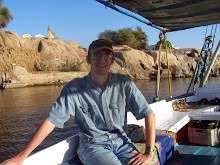
From the hotel we could see the Erg Chebbi, the vast field of sand dunes at the far side of which was the oasis where we would spend the night.As the afternoon started to melt into evening the guides brough a few dozen camels, and everyone began to prepare to set out. The bustle caused the Bostonian professor, who had opted out of this leg of the journey, to say he felt like the keeper of a medieval caravanserai as some huge merchant caravan was about to depart. The camels were all on their knees, and once we had our water and everything else we would need, guide helped us sling our bags by the front of our saddle while we got on the camel, and then the guides got the camels to stand up. Once we were all ready, waving goodbye to the few who were left behind, we set off into the erg.

Riding a camel is not a terribly comfortable experience, and leaves one sore for several days. The erg scenery, however, is beautiful, with pure golden-yellow sand in drifts across crisply blown dunes cut clearly against the cloudless sky ov early evening. Here are there was an occasional blade of grass, or even a tree that looked not so much lolely as relaxed. There were also swift, tiny birds and insects sitting on gray rock ledges occasionally sticking out of the sand. After almost two hours, we got to the oasis, featuring a number of palm trees and shrubberies watered by an aquifer about a meter underground in the shadow of a huge sand dune that took over 45 minutes to climb, but which offered a view of the desert deep into Algeria in an atmosphere of perfect stillness. (No, I didn't make it to the top.)

That night was one which I will likely never repeat, as we camped out in Berber tents in the cool night air beneath the star-filled desert sky. If you wandered around a bit outside of the camp, it was impossible not to fully absorb the vastness of creation, a sense which had been with us at least since the gorges winding through the High Atlas. People can adapt to much of the world, but the world itself inevitably marches on, and only recently have we gained the capacity to affect its core processes, and then only to destroy, not create.

We set out early the next morning to return to our base, and as we passed once more through the drifting dunes of the Erg Chebbi, the desert was already forgetting out passage, as the same sharp morning winds that blew sand into our eyes and threatened to undo the ties on our clothes swiftly wiped out the tracks we left behind us. However, I have not forgotten, nor will I ever, the sense that we are creatures of this world and not its masters, and that there are far greater forces at work than I as an individual will ever be able to control.

Monday, June 21, 2004

Medical Issues

If you have any illness such as diabetes which might cause people around you to have to take steps, please make sure people know about it and what they should do. Even if you think you'll be fine, some pretty scary situations can develop otherwise.

Thursday, June 17, 2004

Meknes, Morocco/Fez al-Jedid, Fez, Morocco

One needs to spend only a little time in Morocco before realizing how close religion is to the hearts of the people. Much of the language is embedded with religious references - the standard greetings all involve God or Quranic phrases of one sort or another. Even cheap hotels often have a small room marked "mosque," as does the American Language Center where I study. Businesses are expected to be closed at 11:30 on Friday to allow employees time to get to the Friday prayers, and even those who don't go often have a radio on where they can hear the sermon.

Moroccans talk about religion all the time. Off the Place de Florence in Fez is an Italian place where we know the waiter, and he often cites mosque sermons when discussing stuff like why he doesn't want to bring up an old argument that seems settled. People often ask what religion you are, and some express interest in your precise sect of that religion, while telling you about the school of Islamic law which they follow. (Most Moroccans and Maliki Sunnis.)

There is, however, another important element to Moroccan Islam, one not found as much in the countries of the Middle East. These are the cults of the walis, the "friends of God" who are similar to Christian saints and believed to possess a divine grace because of their closeness to God. Such holy figures are buried all over the place, such as at the previously described Chellah in Rabat. Usually they are associated with Sufi orders who make annual pilgrimages to their tombs where they, too, hope to have personal mystic experiences of God.

One of the most important walis in Morocco was Sidi al-Hadi Ben Aissa, who lived a little over 300 years ago and was connected to the great Moulay Ismail, an early sultan of the presently reigning Alawite dynasty and ally of France's King Louis XIV who founded a new capital at Meknes in the late 17th century. The Sufi order he founded is actually noted for some rather extreme practices, such as swallowing glass and live snakes. After seeing some of the Moulay Ismail sights, a couple of us set off with a guy named Ben Aissa who was curious about the tomb of this famous person with the same name.

The day was brutally hot, and the relatively narrow lanes of the Meknes medina were a welcome change from the open spaces of the Roman ruins we had seen that morning. Although non-Muslims are forbidden to enter holy sites in Morocco, a practice which results from a long history of Christians in particular showing a lack of respect for them, people were more than willing to point us in the right direction, as we cut all the way through the medina to the Muslim cemetery on the far side. Along the way we saw all the usual sorts of medina shops, including some with glazed donuts which would have looked good in cooler weather. We stopped in one where someone bought a soccer jersey, and as they haggled the shopkeeper offered us all tea as is a common practice.

The mosque of Sidi Ben Aissa itself was set apart from all other buildings, and was white with green trim, green being the color of Islam. We got to the doorway, but unfortunately you could not see the actual tomb from outside. We had a nice conversation with the guardian, who after awhile decided to actually let us step inside up to a point where he thought the tomb could be seen, albeit with difficulty. There Ben tried to get the picture, but three late-middle-aged women came and had sharp words with the door guy, so we had to step out again, and the guardian just took the picture himself.

All of this, and the subsequent further conversation with the guardian and another man who had come to see what all the commotion was about, was conducted in perfect friendliness that puts to rest the notion that Muslims are invariably hostile to non-Muslims around holy sites. In fact, when we got into the discussion of nationality and one person tried to apologize for being an American, the guardian would have none of it, pointed to the sky, and said that before God all men were brothers regardless of where they came from. And when we were about to leave, Ben said his name, causing something of a stir; and the guardian grabbed his arm, took him over to a side window, unlocked it, and flung it open revealing the elaborate tomb of the wali covered with Arabic writing while bystanders started gossiping, "Hey! This American's name is 'Ben Aissa'!"

At one point I asked the guardian a question about walis in Morocco, and in reply he mentioned Moulay Idriss I, founder of Morocco's first dynasty in the late 8th century. In 750 the Abbasid dynasty came to power on a wave of popular discontent with the preceding Umayyads and the belief that a member of the Prophet Muhammad's family should rule as caliph. They were descended from the Prophet's uncle, Abbas, and had a certain interest in marginalizing more direct descendants. Thus Idris, the Prophet's great-grandson, decided it might be a good idea to go to Morocco, where he arrived at the ancient Roman city of Volubilis, high on a hill-top overlooking fertile green valleys near Meknes.

Today Volubilis is in ruins, but its mosaics are remarkably well preserved as the city remained occupied until the 18th century. Today its population consists mainly of snails keeping cool on the underside of tree leaves, tourists marching around with or without guides, and storks who live in roots atop the pillars of the Temple of Jupiter which in taking off resemble airplanes as with wings spread they seem to be lifting off from the ground even though it is really the ground falling way under them. From here Idris, after winning the respect of the people and beginning to consolidate some political control of the area, began the building of Fez as a capital for his new kingdom.

However, Moulay Idris was to live here for only a couple of years before at last the assassins of the Abbasid caliph Harun al-Rashid (of 1001 Nights fame) caught up with him, and he fell of poison, a martyr to his followers, who buried him in a magnificient tomb on a nearby hillside where today a town named Moulay Idriss is clearly visible from Volubilis. That town, considered the holiest city of Morocco, is its most important pilgrimage destination, and for centuries was closed to non-Muslims, but today people will welcome you, and even urge you to step up farther in the mausoleum until you come to a marker beyond which non-Muslims may not pass. There are also guides who can show you the viewing platforms which allow anyone to look down into the courtyard of the mausoleum at the bright green roof of the burial chamber.

Amidst all this, it is of course easy to forget that there is another important religious tradition present in Morocco, one which has been present for centuries but which came in the greatest numbers in the 1400's when the Christians drove them out of Spain during the Reconquista. These are the Jews, and though today their numbers have dwindled their culture and holy sites remain throughout the country. Fez is the home of the original "Jewish Quarter" in Morocco, built as part of Fez al-Jedid originally to house the Jewish refugees from Spain, a legacy seen clearly in the open housing style with large windows and wooden balconies looking out over the streets. Today this quarter remains, in the shadow of the vast royal palace, called by the locals the "Street of the Jews" though only seven Jewish families remain here today, with the other 5000 individuals scattered throughout the city.

Fez al-Jedid is only a 15-minute walk from our part of the Ville Nouvelle, and is a good place to go if you want to feel like you're in Morocco and not France. The high buildings and narrow streets make walking around there a cooler experience, and the shops include a large number of electronics, music, and (frequently imitation) name brand goods. There is also an extremey large number of dentists, all with signs featuring smiling teeth. One place to visit is the newly restored Ibn Danan Synagogue, listed as a UNESCO World Heritage Site, where you can see the Torah scrolls covered in red cloth and an admittedly moldy if deep mikveh in the basement. More interesting, however, is the Jewish cemetery, through a black gate in the walls of Fez al-Jedid and home to a blinding sea of 18,000 white graves dating from at least the 1600's to January 2004. Among them is one black one covered with Hebrew script - because of the large number of candles placed in a small compartment venilated by a smoke stack we guessed it was probably the grave of a miracle worker, while further up the hill was an elegant white tomb with green trim belonging to a young girl martyred for refusing to marry the governor of Tangier.

Somewhere around here there was supposed to be a museum about Moroccan Jews who had left for Israel, but we were having problems with hustlers and didn't want to fight it then; still, as that sounds like a highlight, I hope to return. Until then, it is perhaps presumptuous to try to put together a comprehensive picture of the religious picture in Morocco. However, while there is certainly a presence of Islamic fundamentalists I'm just not running into, Morocco is arguably one of the least fundamentalist places around. The call to prayer is in the Wahhabi style - a flat monotone to avoid sounding too much like music - but aside from that legacy of the puritan Almohads from centuries ago Morocco today shows little inclination to part from its distinct heritage of personal religion and folk traditions. In fact, I've met some Moroccans who refuse to identify themselves as Sunni or Shi'ite and say only that they are followers of Sufism.

Perhaps the best statement I've heard of liberal Moroccan attitudes came from a guy in a restaurant who gave his favorite verse from the Qur'an, which translated means "What is licit and illicit is clear." This he applied not only to Islam, but to all religions, saying that right and wrong were not complex questions and everyone agreed on the basics. This, of course, is something the student of comparative religion will quickly notice, and its application in the lives of people is a comfort to live around.

Monday, June 14, 2004

France 2, England 1

Seriously, I wouldn't have been surprised to hear this soccer score somehow integrated into the call to prayer this morning. Everyone was into it, and at least one cafe set a huge big-screen TV outside where people sat around watching it. Moroccans apparently root for the French soccer team as well as speak the language, so the whole national uprising against the colonial power thing seems to be pretty much gotten over.